
 Hosting service
Platforms and portals, Bayanno.com , 2024
Rebuilding an abandoned news site into a Bengali portal we now run
A Bengali-language news website with a deep category structure, video reports and district news.
Visit the site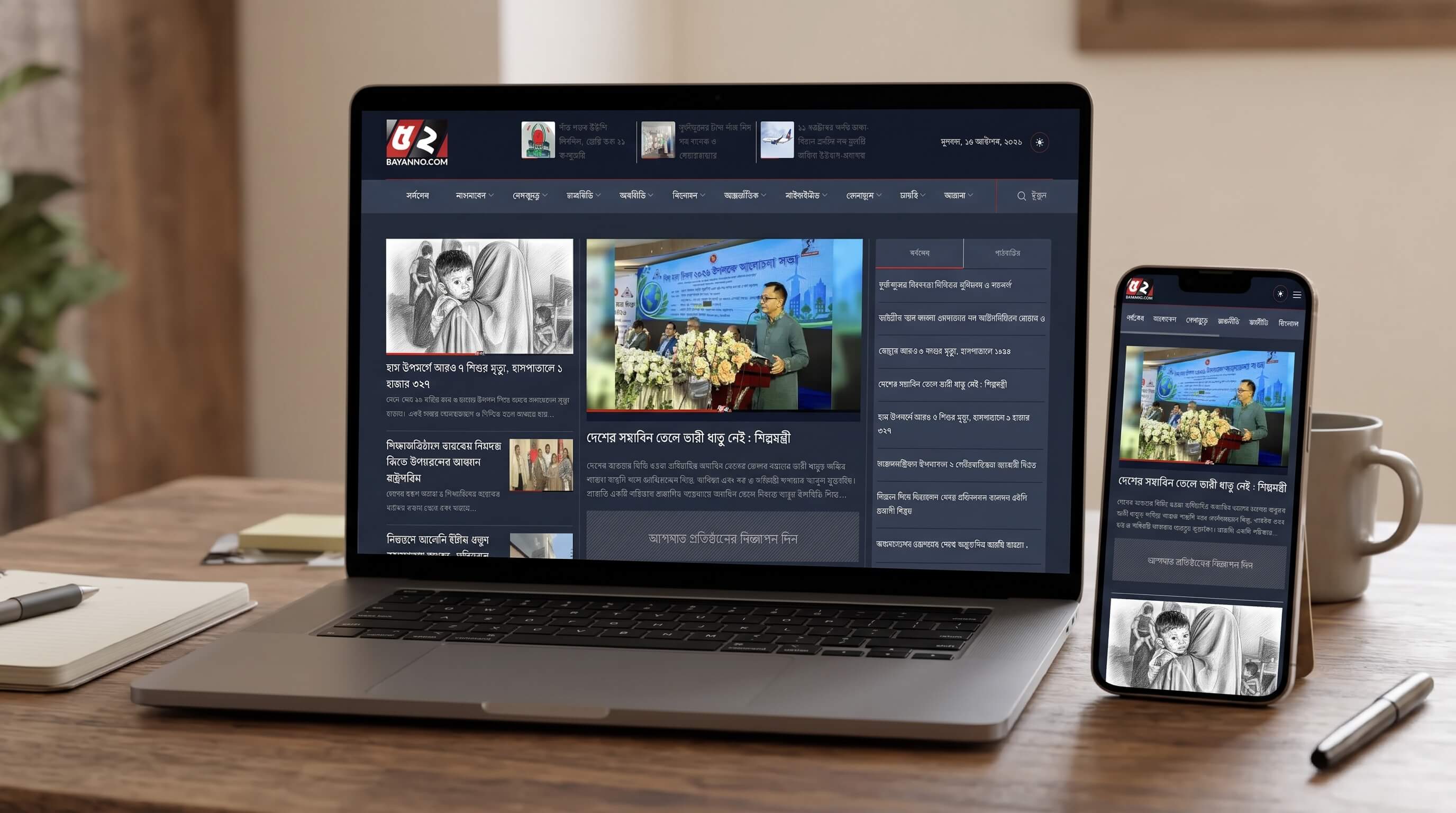
Overview
Bayanno.com is a Bengali-language news portal with national and district coverage, politics, economy, entertainment, sport, jobs, international news and video reports. Its first website was a custom PHP content system whose developer had walked away. We moved the newsroom onto WordPress, ran it for several years, and then rebuilt it as a custom Laravel platform that we host and support today.
The challenge. A newsroom publishes all day and cannot wait for a developer. Bayanno's old system was bloated with features nobody used, nobody maintained it, and the people who relied on it had no one to call. The site needed a front page the editors could control, a fast reading experience on phones, and a safe way to carry a large archive of old stories across.
What we built. A news platform with its own editor, a homepage assembled from rows and widgets that editors rearrange, a district map for local news, search, topics and special events, reporter profiles, AMP pages, news sitemaps and an RSS feed. Over about 190 commits between January 2024 and June 2026 we added roughly 46,800 lines of authored code.
The result. Editors run the front page themselves, old links keep working, and the platform has carried more than 35,000 stories published in 2024 and 2025. We monitor it, tune it and support it (details under "What changed for the newsroom").
The Bayanno homepage in dark mode, with the top story, latest news and section menu
Feature list
Every item below traces to a commit, a migration or a screen in the project history, grouped by what it does for the newsroom and its readers.
| Area | What the newsroom and readers get |
|---|---|
| Writing a story | A post editor with a shoulder line, headline, sub-heading and slug; a rich-text body; content blocks for headings, quotes, text, images and embedded stories; a featured image with credit and caption; video embeds; photo galleries; live posts; and private posts |
| Organising stories | Nested categories with a primary category, topics, a district for local news, reporter profiles and focus keywords |
| Running the front page | A homepage built from rows and components that editors reorder, plus lead, body and above-menu slots with their own priority and a reset-sorting button |
| Reading | Latest and most-read tabs, related stories, category pages with their own widgets, topic pages, dark mode, share buttons and a layout that works on a phone |
| Local news | A Bangladesh district map and district search so a reader can go straight to their own area |
| Seasonal and event pages | A Sehri and Iftar time widget for Ramadan, and a special event and topic system with its own sort order |
| Search | Site search, an all-posts page with filters, and related keywords shown as hashtags |
| Search engines and feeds | Search-friendly metadata, a sitemap for posts, categories and authors, a news sitemap, an RSS feed and AMP pages |
| Keeping old links alive | Permanent redirects from the old URL patterns to the new story pages, and a fall-back to the archive for older stories |
| Speed | Cached category and homepage queries, Redis, LiteSpeed cache that is cleared when a story changes, and view counts recorded in the background |
| Administration | A Filament admin with roles and permissions, a media library, menus, site settings, a post count report, a Google Analytics widget and a system tools page that clears caches |
The development journey
The work came in four overlapping phases.
1. A publishing system the newsroom could own (January to March 2024)
Challenge. The old site could not be edited by anyone who understood it.
Solution. We built the first version on Laravel and Filament: posts, categories, menus and media, with roles and permissions from the start. A first usable version existed within two weeks, and nested site menus followed in March.
2. The reader's site (June to August 2024)
Challenge. A news home page has to show the right story first and load quickly on a mid-range phone.
Solution. We designed the homepage around lead, body and above-menu slots and a layout builder, then added most-read and latest tabs, related stories, dark mode and a design pass that matched the site's brand. Sitemaps, AMP pages, an RSS feed and reporter profiles followed within weeks.
3. Local news and special coverage (August 2024 to March 2025)
Challenge. Much of Bayanno's value is local, and some events, such as Ramadan, need their own pages.
Solution. We added a division and district system with a map and a district search on the home page, a special event and topic system with its own ordering, new home page widgets, and a Sehri and Iftar time widget.
The Bayanno top story on a phone in dark mode, with the section menu
The Bayanno top story on a phone in light mode
The Bayanno Bangladesh section on a phone, with sub-sections and the lead story
4. Speed, safety and operations (2025 to June 2026)
Challenge. A busy news site is read by many people at once, and a slow category page or a failing cache costs readers.
Solution. We removed repeated database queries on story and category pages, cached the category tree, recorded story views in a background job, cleared the cache whenever a story changes, and added access policies for the admin resources. A system tools page now lets staff clear the cache without a developer. Stories can fall back to the archive, so old links never end on an error page.
Feature highlights
The front page belongs to the editors. Rows and components can be reordered, and any story can be marked as a lead, a body story or an above-menu story with its own priority. Changing the front page needs no developer.
Every story is complete. A story carries a shoulder line, sub-heading, reporter, categories, topics, district, focus keywords, a credited featured image and, when needed, a video, a gallery or a live feed. Editors can also keep a story private until it is ready.
Local readers find their area. The district map and district search turn the home page into a way in to local news.
Search engines get what they need. Each story has metadata, appears in the post, category, author and news sitemaps, and has an AMP version and a place in the RSS feed.
Old links survive. Legacy URL patterns redirect permanently to the new story address, so links from years of earlier publishing keep working.
The site stays quick. Story and category pages load only the relations they use, cached categories are reused for an hour, view counts are written by a background job and the page cache is purged when a story changes.
Staff stay in control. A system tools page, a post count report and an analytics widget sit in the admin, with roles and permissions so each person sees only what their job needs.
What changed for the newsroom
| Before | What we did | What changed |
|---|---|---|
| A custom PHP system nobody maintained | Moved to WordPress, then rebuilt on Laravel with a Filament admin | One team owns the platform, with support, and the newsroom has someone to call |
| A story page that ran extra queries for every category and image | Loaded the story with its categories, media and primary category in one go | A story page now needs 3 queries instead of a number that grew with every category |
| Counting a view slowed the page | Moved view counts to a queued job | Readers do not wait for the counter |
| A stale cache after an edit | Purged the page cache on story events and added a one-click cache clear | Edits show quickly and staff can fix a stale page themselves |
| Older stories and links in a previous system | Archive fall-back and permanent redirects | Old links lead to the story, not to an error |
More than 35,000 stories were published on the platform in 2024 and 2025 (from the live database, December 2025).
Engineering by the numbers
From January 17, 2024 to June 17, 2026 the project history records 188 commits. They add about 46,800 lines of authored code and remove about 5,500. Adjusted to a common PHP-equivalent measure, that is about 42,500 lines, and the effort is estimated at about 465 hours, or roughly 58 working days. The estimate range is wide (about 250 to 1,170 hours) because it comes from commits, not time sheets.
What it adds up to
Bayanno now has a publishing system built around how a Bengali newsroom works: stories with their local context, a front page editors control, a site that readers can find and use on a phone, and a team behind it. We host it, keep it fast and keep improving it with the people who use it every day.
More work
E-Zone HRM Limited · Platforms and portals
A job portal that holds more than 120,000 candidates and runs every shortlist
EZ Jobs BD: a job portal and applicant tracking system where candidates build resumes and apply, and employers and recruiters review, shortlist and invite.
- Laravel
- Livewire
- Filament
- Tailwind CSS
Fiction Factory · Platforms and portals, 2026
Turning a story site into a self-running literary community
A Bengali-first home for writers and readers: short stories, serialised books, rewards, a social feed and paid chapters, built and run by us.
- Laravel
- Livewire
- Filament
- Reverb
Tell us what you want to build
A short message is enough. We reply within one working day with questions or a next step.